beginnerFree
Why Collections?
Arrays vs Collections - know the difference
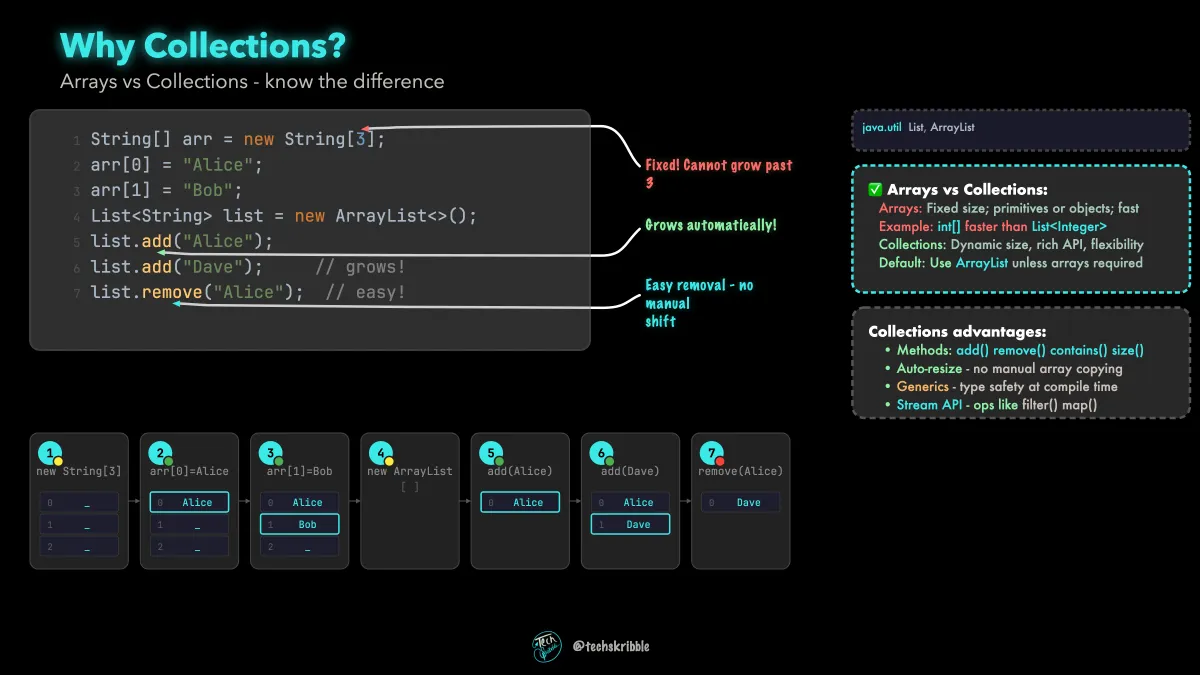
Arrays are fixed-size. Collections grow, shrink, and provide powerful methods.
Watch
The narrated version of this skribble — tap play for the full-size video.
0:00 / 2:26
Deep dive
The Big Picture
Collections make data-structure tasks easier: dynamic sizing, searching helpers, sorted/unique types, and key-value maps.
- Arrays are fixed size - collections grow automatically
- Built-in methods for
add,remove,contains,sort - Type-safe with generics:
List<String>
Most real-world Java code needs collections, not arrays.
How It Works
Collections encapsulate their backing storage and resizing for you.
ArrayListgrows its backing array as needed (amortized O(1) add)HashSetuses hashing for average O(1) contains checksTreeMapuses red-black tree for sorted access- Each implementation optimizes different operations
- Generics prevent type errors at compile time
In the Java Landscape
Before the Collections Framework, Java had arrays plus legacy types like Vector, Hashtable, Stack.
- Collections Framework (Java 1.2) unified data structures
- Generics (Java 5) added type safety
- Streams (Java 8) added functional processing
- Factory methods (Java 9+) simplified creation
- Kotlin, Scala extend Java collections with richer APIs
Pitfalls and Best Practices
- Default to
ArrayListfor lists,HashMapfor maps - Use
Setwhen uniqueness matters, notList - Collections over arrays for most use cases
- Avoid legacy types:
Vector,Hashtable,Stack - Profile before choosing exotic implementations