beginnerFree
Constructors
Initialize objects - same name as class, no return type
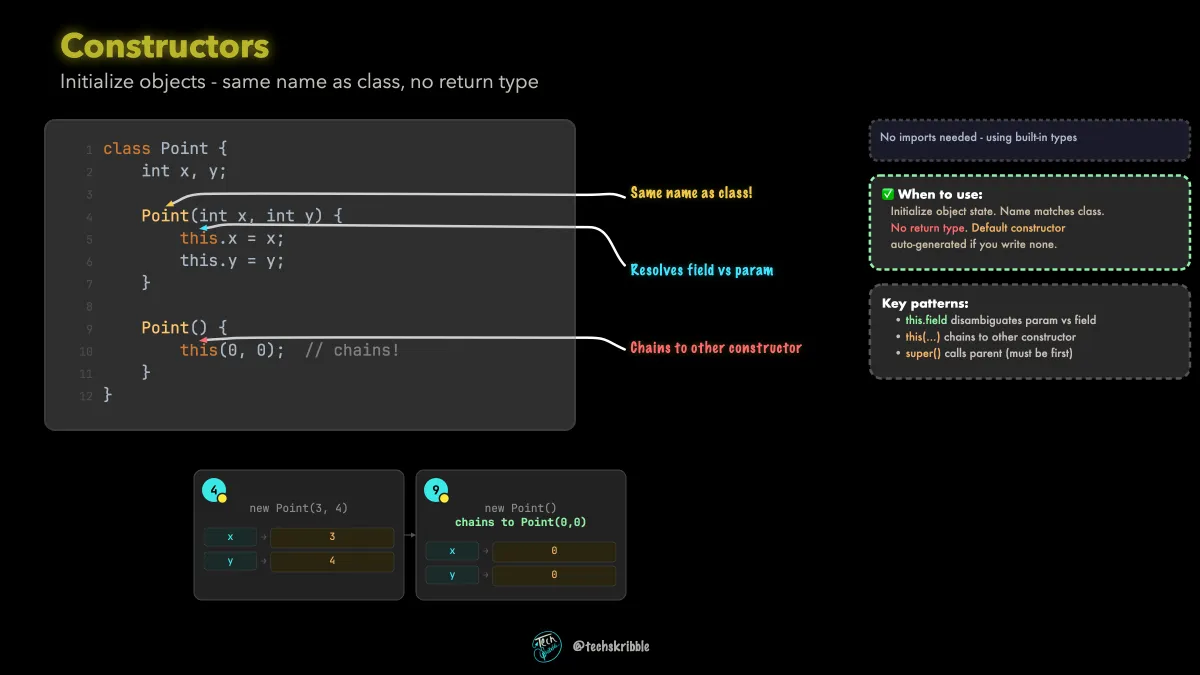
Constructors run when you create an object. Use them to set initial state.
Watch
The narrated version of this skribble — tap play for the full-size video.
0:00 / 2:19
Deep dive
The Big Picture
Constructors initialize objects when you call new. They set initial state, validate inputs, and allocate resources.
- Same name as the class, no return type
- Can be overloaded with different parameters
- Run once per object creation, before any other access
Every class has at least one (default or explicit).
How It Works
No explicit constructor? Java provides a no-arg default. Add any constructor and the default disappears.
- Chain with
this(...)to delegate within same class super(...)explicitly calls a parent constructor; else Java inserts super()- Superclass constructor always runs first
- Fields initialize before constructor body executes
In the Java Landscape
Java 16+ records auto-generate canonical constructors.
- Builder pattern avoids telescoping constructors
- Static factory methods (
of(),create()) often replace them - DI frameworks (Spring) call constructors to wire beans
- Lombok
@AllArgsConstructorgenerates constructors - Copy constructors for defensive copying
Pitfalls and Best Practices
- Validate parameters - fail fast with
IllegalArgumentException - Don't call overridable methods in constructors
- Consider static factories when named creation/validation/caching helps
- Use
this(...)chaining to avoid duplicate logic - Keep constructors simple - complex logic in factories
- Document required vs optional parameters