beginnerFree
The main() Method
Where every Java program begins
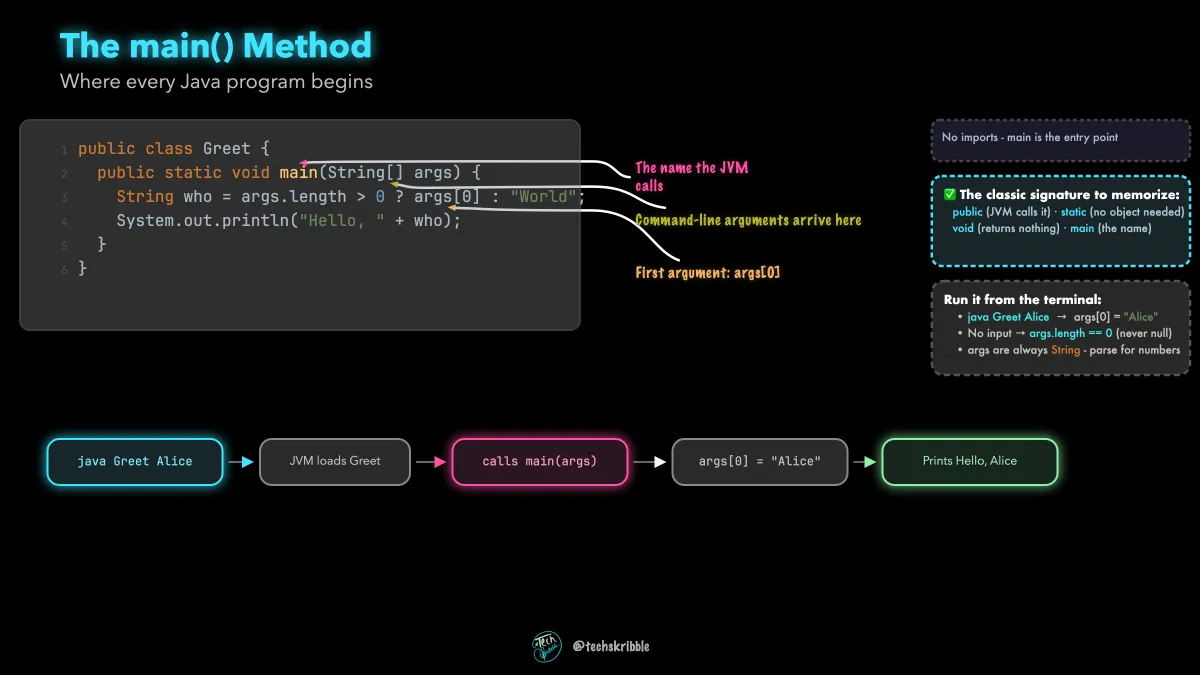
The JVM starts your program by calling public static void main(String[] args). Command-line arguments arrive in args.
Watch
The narrated version of this skribble — tap play for the full-size video.
0:00 / 2:16
Deep dive
The Big Picture
main is the single entry point the JVM calls to start your program. The classic signature must match this form or the JVM won't find it.
public- reachable from outside the class (the JVM calls it)static- runs without creating an object firstvoidreturns nothing ·String[] argscarries command-line input
How It Works
The java launcher loads your class, then the JVM invokes main on the "main" thread. Tokens typed after the class name become args.
java Greet Alice Bob→ args = {"Alice", "Bob"}- Every element is a
String- parse numbers withInteger.parseInt - The shell splits on spaces; quote to keep a token together
In the Java Landscape
The classic form is stable, but a few variants are worth knowing.
String... args(varargs) is an equally valid signatureSystem.exit(int)sets the process exit code (0 = success)- Java 25 finalizes a simpler instance main + compact source files
(preview in Java 21-24) - the classic form still works everywhere
Pitfalls and Best Practices
- A signature typo →
"Main method not found"- the JVM won't start argsis never null but can be empty - guardargs.length- Reading
args[0]with no input →ArrayIndexOutOfBoundsException - Keep main thin - delegate real logic to other methods/classes