beginnerFree
Encapsulation
Private fields + public methods = controlled access
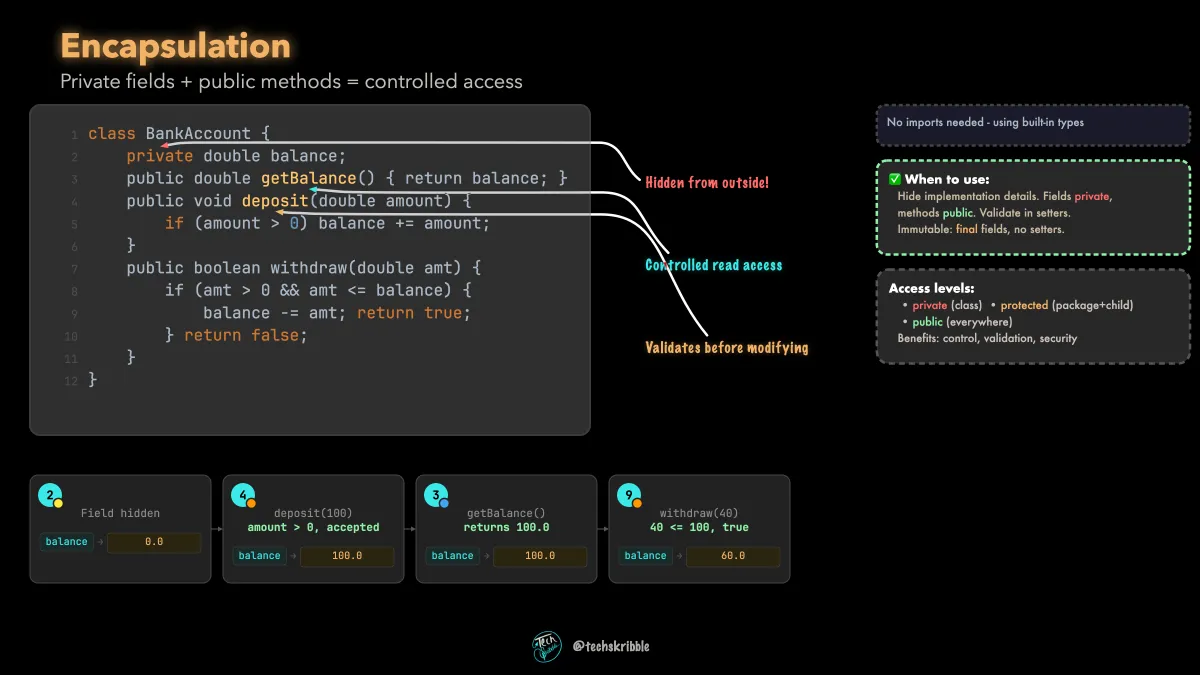
Encapsulation hides internal data and exposes it only through methods.
Watch
The narrated version of this skribble — tap play for the full-size video.
0:00 / 2:20
Deep dive
The Big Picture
Encapsulation hides internal state behind private fields and public methods. Protects invariants and decouples impl.
- "Black box" design - users don't see internals
- Prevents invalid state (negative age, null fields)
- Allows changing internals without breaking clients
Foundation of maintainable, safe code.
How It Works
The compiler enforces access modifiers: private, protected, package-private, public. Reflection can bypass (opt-in).
- Getters/setters provide controlled access
- Immutable classes (
finalfields) maximize safety - Defensive copies prevent reference leaks
- JVM also performs access checks at runtime
In the Java Landscape
JavaBeans convention uses get/set method naming.
- Records (Java 16+) auto-generate accessors
- Lombok
@Getter/@Setterreduces boilerplate - Modules (Java 9+) encapsulate entire packages
- Sealed classes restrict who can subclass/implement a type
- Builder pattern for complex object construction
Pitfalls and Best Practices
- Default to
private, widen only when needed - Return copies of mutable collections, not originals
- Validate in setters: throw
IllegalArgumentException - Avoid
publicfields except constants (static final) - Use builder pattern for complex construction