Variables & Primitive Types
The building blocks of Java data
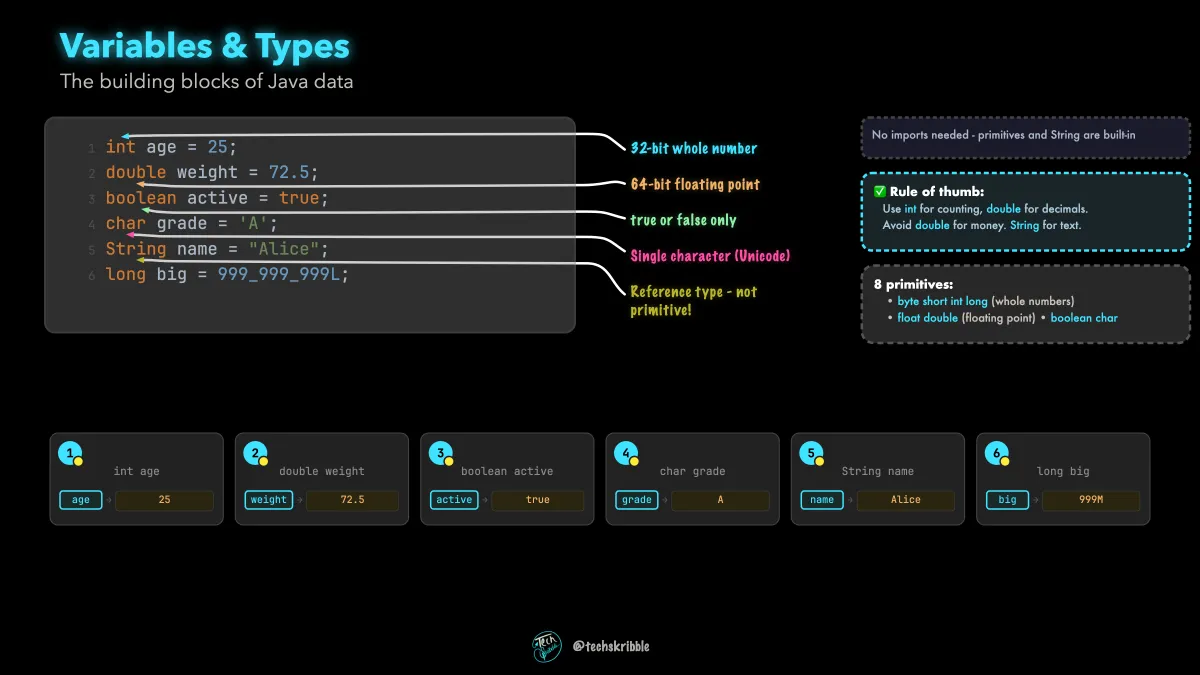
Java has 8 primitive types plus reference types like String. Every variable must declare its type.
Watch
The narrated version of this skribble — tap play for the full-size video.
Deep dive
The Big Picture
Variables store data your program needs to work with. Java is statically typed - every variable declares its type at compile time, catching errors early.
- Primitives:
int,double,boolean,char(8 total) - References:
String, arrays, objects, interfaces - Scope: local, instance (field), or class (
static)
How It Works
Local primitives sit in the stack frame (fast, fixed size). Fields & array elements live on the heap with their object.
int: 32 bits,long: 64 bits,byte: 8 bitsfloat: 32-bit floating point,double: 64-bit floating point- Default values:
0for numbers,falsefor boolean,nullfor refs
Local variables have no default - must initialize before use.
In the Java Landscape
Java 10+ adds var for local type inference:
var list = new java.util.ArrayList<String>();- Type inferred at compile time, still strongly typed
Wrapper classes bridge primitives and objects: Integer, Double Records (Java 16+) generate fields and accessors automatically. Pattern matching for instanceof (Java 16+) combines type check + variable.
Pitfalls and Best Practices
- Use
finalfor values that shouldn't change - Avoid
floatfor money - useBigDecimalinstead - Don't compare floats with == (precision issues)
- Initialize variables close to first use
- Prefer narrow types:
intoverlongif range fits - Name clearly:
userAgenotx