beginnerFree
Wrapper Classes
Autoboxing - primitives meet objects
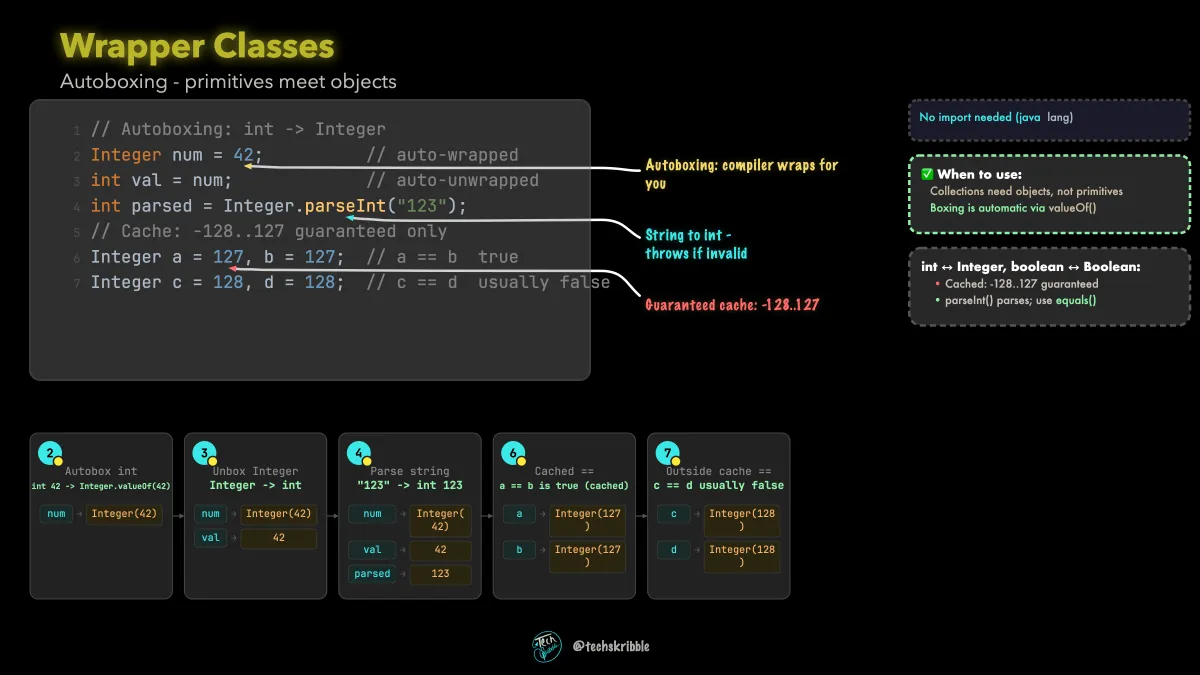
Wrapper classes let primitives act as objects. Autoboxing handles conversion automatically.
Watch
The narrated version of this skribble — tap play for the full-size video.
0:00 / 2:18
Deep dive
The Big Picture
Wrappers convert primitives into objects: int to Integer. Required for collections, generics, and object-expecting APIs.
- Each primitive has one:
int/Integer,char/Character - Autoboxing/unboxing converts automatically
- Immutable - values can't change once created
Utility methods: Integer.parseInt(), Double.isNaN()
How It Works
Autoboxing: Integer x = 42 calls Integer.valueOf(42). Unboxing: int y = x calls x.intValue().
- Cached values:
Integer.valueOf(-128 to 127)reused - Outside it, == is not portable - use equals()
- Parse strings:
Integer.parseInt("123") - Convert back:
String.valueOf(42)
In the Java Landscape
Collections require objects: List<Integer> not List<int>.
- Autoboxing (Java 5+) made wrappers mostly transparent
- Primitive streams avoid boxing:
IntStream,DoubleStream OptionalInt,OptionalDoublefor primitive optionals- Valhalla project (future) may allow
List<int> - Records keep declared types; normal boxing applies
Pitfalls and Best Practices
- Don't use == for wrappers (cache boundary surprises)
- Always use
equals()for wrapper comparison - Null unboxing throws
NullPointerException - Avoid autoboxing in tight loops (GC pressure)
- Prefer primitives for performance-critical code
- Use primitive streams (
IntStream) in pipelines