beginnerFree
Control Flow
if/else - make decisions in code
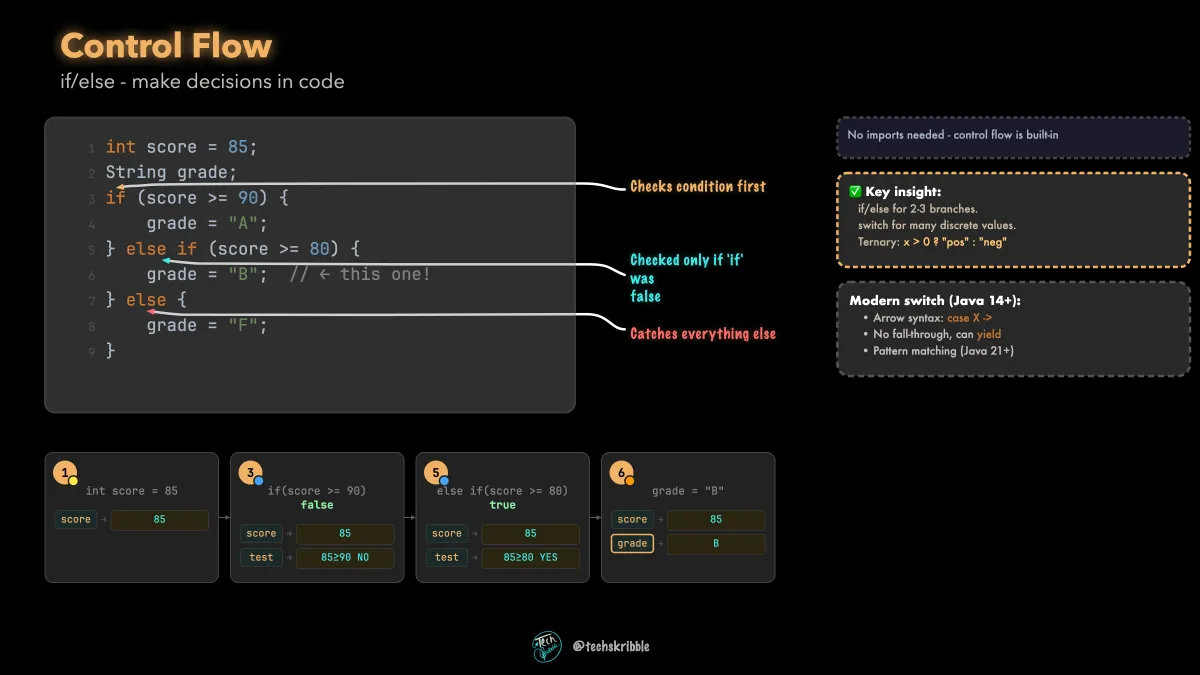
Control flow lets your program choose different paths based on conditions.
Watch
The narrated version of this skribble — tap play for the full-size video.
0:00 / 2:17
Deep dive
The Big Picture
Control flow directs which code runs based on conditions. Without it, code runs top to bottom every time.
if/else: basic branchingswitch: multi-way branching on a value- Ternary:
condition ? valueA : valueB
Every program beyond hello-world uses control flow.
How It Works
The JVM evaluates boolean expressions and jumps to branches.
ifevaluates once;else ifchains checked in order- Short-circuit:
&&stops if left is false switchcan compile to a jump table; mainly clearer than long if/else- Java 14+ switch expressions return values directly
- Pattern matching (Java 21+) adds type checks to switch
In the Java Landscape
Control flow is fundamental - used in every Java construct.
- Modern switch (Java 14+):
case "A" -> doA(); - Java 21 pattern switch + sealed types enables exhaustive type switches
Optionalreduces null-checking if/else chains- Streams replace some conditional loops with
filter() - Strategy pattern replaces complex if/else with polymorphism
Pitfalls and Best Practices
- Always use braces even for single-line
ifblocks - Don't nest more than 3 levels deep - extract methods
- Use early returns to flatten nested conditions
switchfall-through is a common bug - usebreak- Prefer switch expressions (Java 14+) - no fall-through
- Replace boolean flags with meaningful method names